
Google’s August 2026 Spam Update: What Franchise Websites Should Check

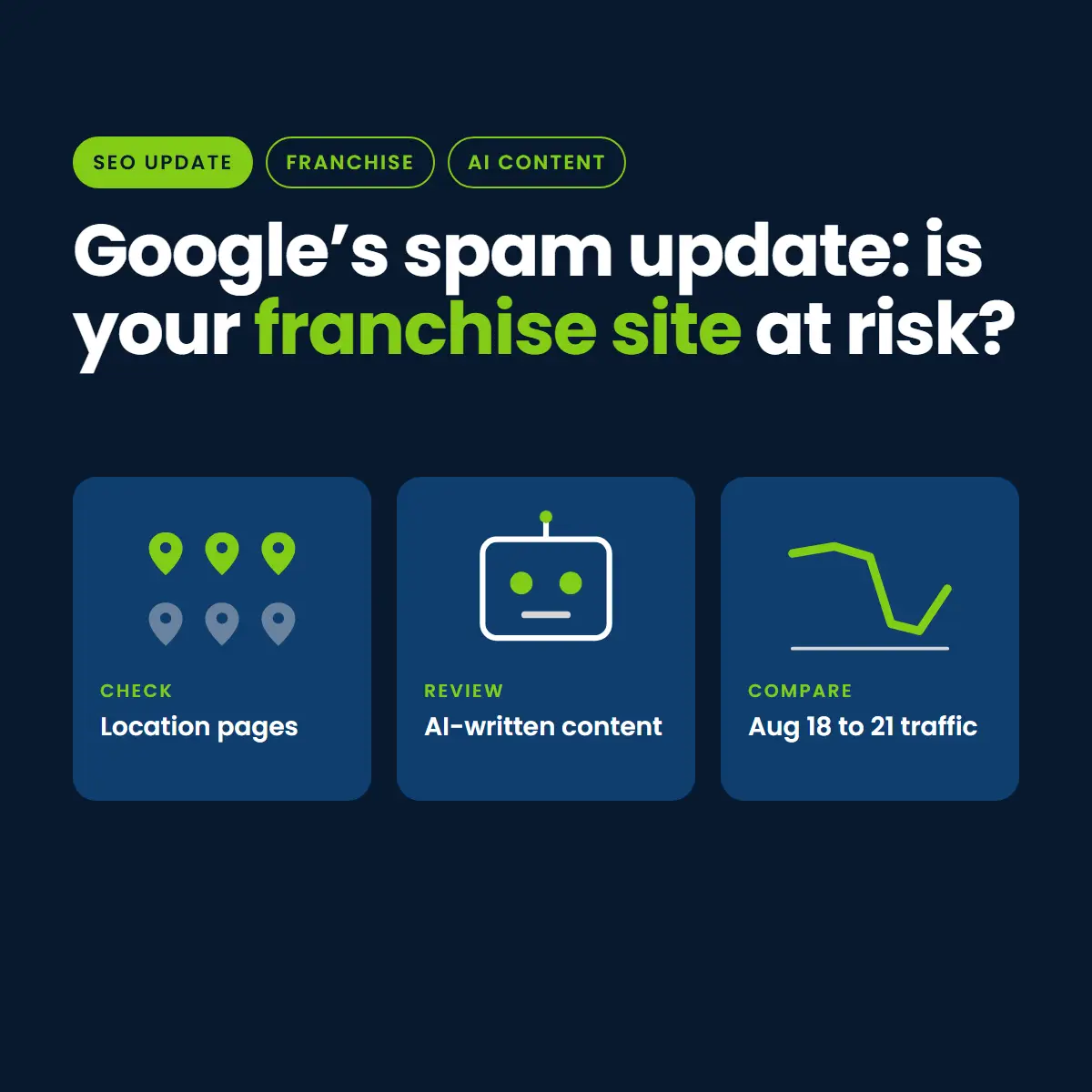
If your franchise or multi-location home service site slipped in the rankings this fall, Google’s August 2026 Spam Update is one of the first things worth ruling in or out.
Industry reports suggest the update went after sites that publish AI-generated content at scale mainly to rank. Google has not confirmed that focus, so treat this as a signal to audit, not a verdict. Here is what was reported, why franchise sites carry extra risk, and a practical way to check your own.
What Was Reported About the August 2026 Spam Update
Search Engine Journal summarized early reports that the update filtered sites running automated, mass-produced AI content. The reports are anecdotal and the samples are small, but a few themes repeated:
- Sites that were fully automated from day one appeared to be hit hardest.
- Sites that began with human-run content and later switched to automated posting sometimes held up, possibly because of earlier history and engagement.
- Several people argued the production method matters more than whether AI was used at all.
- Keyword-first content, written to match a search phrase rather than to help the reader, has been struggling for a couple of years regardless.
The window people pointed to for checking rankings was August 18 to 21. Google has not said the update was only about AI content, and nothing here proves a penalty on any specific site.
Why Franchise and Multi-Location Sites Carry Extra Risk
Franchise sites are built to scale. One service page becomes fifty city pages, and the fastest way to fill them is a template with the city name swapped in, often with AI help. That is exactly the pattern a spam system is designed to notice.
- Near-identical location pages: the same paragraphs with a different city, no local facts, no local proof.
- Mass-generated service-by-city pages: hundreds of pages created in one batch with thin copy.
- Franchisee-level content with no oversight: every location publishing its own AI posts under one domain.
- Keyword-stuffed headings: pages written for the phrase, not for the homeowner calling about a leaking water heater.
None of this means AI is off limits. It means volume without human review, local specifics, and real usefulness is the risk.
How to Check Whether You Were Affected
1. Compare the right dates in Search Console
Pull clicks and impressions for the week before August 18 and the week after August 21, then look at the pages and queries that moved, not just the site total.
2. Separate this from other causes
A drop that lines up with a website relaunch is usually something different: missing redirects, a leftover noindex, wrong canonicals, or dropped titles. Rule those out first. Our guide to common SEO mistakes covers the usual suspects.
3. Audit your location pages
Open five location pages side by side. If you can swap the city name and the pages read the same, they are thin. Look for local facts, real photos, a named team or office, local reviews, and a clear service area.
4. Review how content gets produced
Who writes it, who edits it, and who approves it before it goes live? If the answer is nobody, that is the first thing to fix. Our post on site structure for local SEO shows how to organize locations so each page has a clear purpose.
What to Do If Your Location Pages Are Thin
- Merge or remove pages that add nothing, and redirect them to the best match.
- Rewrite priority locations with local detail a competitor could not copy.
- Keep AI as a drafting tool, with a human adding facts, checking accuracy, and signing off.
- Fix tracking first, so you can tell a real ranking loss from a reporting gap.
- Do not rush a mass delete. Change the highest-value pages first and measure.
If you run a franchise network, our franchise SEO and multi-location marketing work is built around exactly this: unique, useful pages per location, under one clean site structure.
The Bottom Line
The August 2026 Spam Update is still being studied, and the reports are early. The lesson holds either way: pages made to rank, at scale, without a human making them useful, are the ones at risk. Pages that help a real customer in a real city are the ones to build more of.
Want a second set of eyes on your rankings?
👉 Book a free traffic and location-page review with Nation Media Design
No. Reports and Google research on spam networks point that way, but Google has not confirmed that the update was only about AI content.
AI use alone is not the issue. Content made mainly to manipulate rankings, especially at scale with no human review, is the concern.
Compare Search Console clicks and impressions before August 18 and after August 21, by page and query, and rule out relaunch problems such as missing redirects or leftover noindex tags.
Not in bulk. Fix or merge the highest-value locations first, redirect removed pages to the closest match, and measure before changing more.