
Most people still believe that AI tools like ChatGPT simply “know” things. They don’t. AI engines rely on structured signals, authoritative content, and verifiable data to determine what information is worth surfacing. If your content isn’t built the right way, it won’t just struggle to rank—it won’t be referenced at all.
As search behavior rapidly shifts toward AI-driven answers, understanding how these systems evaluate content is no longer optional. It’s the foundation of modern SEO.
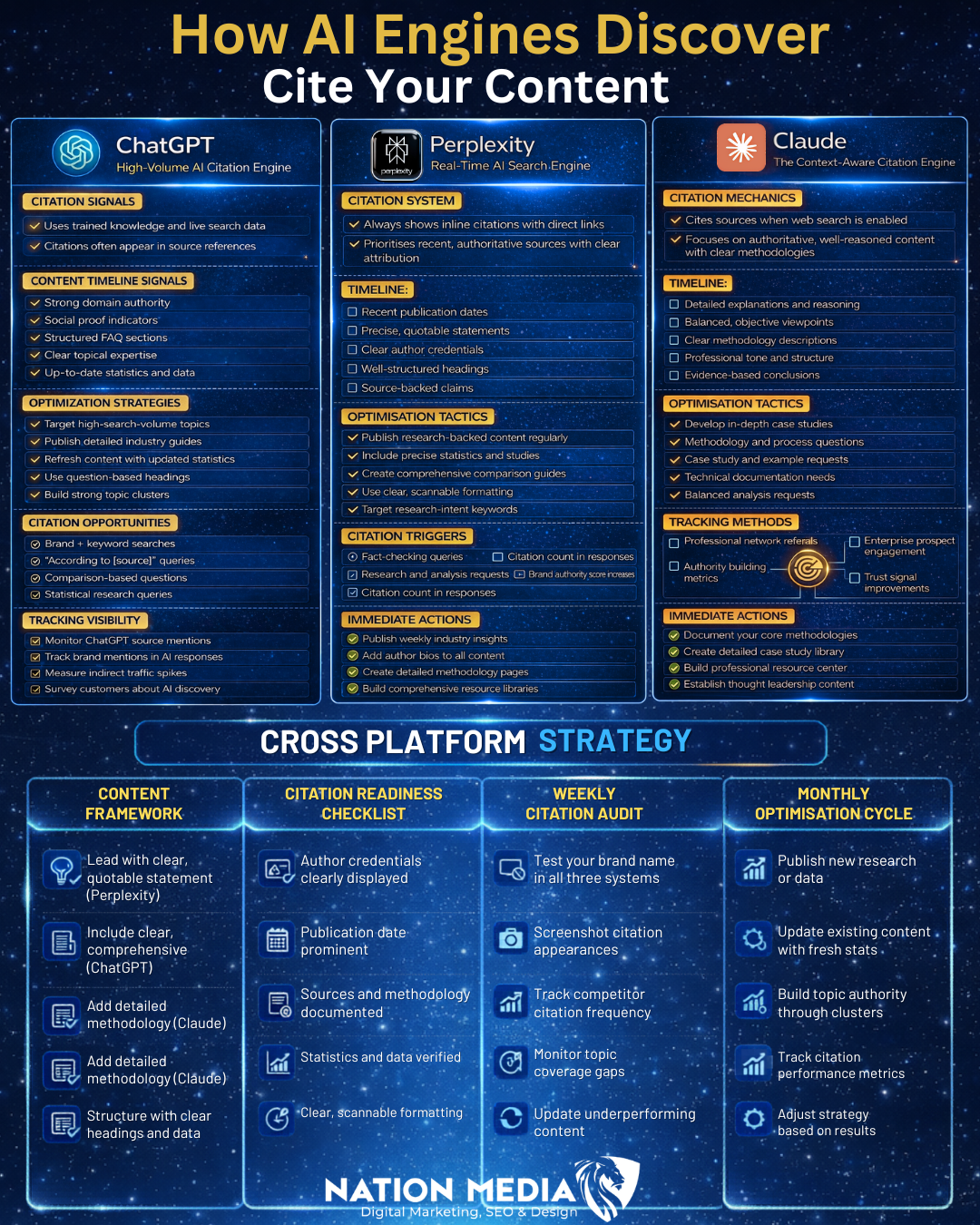
Ready to turn your content into an AI-cited authority source? Download our free AI SEO optimization guide to learn exactly how to structure, write, and scale content that gets discovered and referenced by platforms like ChatGPT, Perplexity, and Claude. Start building smarter content today and stay ahead of the future of search.
Traditional SEO focused on ranking web pages in search engines like Google. While rankings still matter, visibility today increasingly depends on whether your content is selected and cited by AI platforms.
Tools like ChatGPT, Perplexity, and Claude don’t just list links—they generate answers. Those answers are built from sources they trust, which means your goal is no longer just to rank, but to become a trusted reference point.
This shift changes everything. It places greater emphasis on clarity, authority, and structure over simple keyword targeting.
ChatGPT tends to prioritize content that demonstrates strong topical authority and clear organization. It looks for content that is easy to interpret, well-structured, and backed by credible information.
Pages that include defined sections, logical flow, and FAQ-style content are easier for AI to extract meaning from. When combined with updated statistics and a clear demonstration of expertise, this type of content becomes significantly more likely to appear in AI-generated responses.
Another important factor is topical depth. Websites that build clusters of related content—covering a subject from multiple angles—signal authority. This makes it easier for AI systems to trust the content and reference it when answering user queries.
Without this level of structure and authority, even well-written content can be overlooked.
Perplexity operates more like a real-time AI search engine, which means it places a strong emphasis on recency and accuracy.
Content that clearly shows when it was published, includes verified data, and references credible sources is far more likely to be cited. Unlike traditional SEO, where older authoritative pages can still perform well, Perplexity consistently favors content that is current and supported by evidence.
Equally important is formatting. Content that is broken into clear sections with descriptive headings allows the platform to quickly identify relevant information. This makes scannability a key ranking factor within AI-driven environments.
In short, if your content is outdated, unstructured, or unsupported by data, it becomes far less competitive.
Claude takes a different approach, focusing heavily on depth, reasoning, and quality of thought.
Rather than prioritizing quick answers, it leans toward content that explains the “why” behind the information. Pages that include case studies, documented methodologies, and step-by-step processes perform significantly better in this environment.
Balanced perspectives and professional tone also play a role. Claude favors content that is thoughtful, well-reasoned, and supported by evidence, rather than content that is overly simplified or purely promotional.
This means that creating surface-level content is no longer enough. Depth and clarity are essential if you want to be included in AI-generated insights.
While each AI platform evaluates content differently, there is a clear overlap in what they prioritize.
At the core, AI engines favor content that is structured, credible, and easy to extract information from. This includes clearly written insights, strong organization through headings, and the presence of verifiable data.
Content that includes identifiable authorship, visible publication dates, and documented sources sends strong trust signals. These elements help AI systems determine whether the information is reliable enough to reference.
Equally important is clarity. AI systems are designed to interpret and reuse information, so content that is concise, well-organized, and logically structured has a significant advantage.
Creating AI-friendly content requires a shift in how content is written and structured.
Instead of focusing solely on keywords, the emphasis should be on delivering clear, quotable insights that can be easily extracted and reused. This means writing with intention, ensuring that key ideas are directly stated and supported by evidence.
Content should also be built in layers. Foundational pages should cover core topics, while supporting blogs expand on related subtopics. This creates a network of content that reinforces authority and improves visibility across AI platforms.
Regular updates are another critical component. As information changes, content must be refreshed to remain relevant. AI systems are more likely to trust and cite content that reflects current data and up-to-date insights.
The majority of websites are still operating under outdated SEO strategies. They focus heavily on keywords but ignore structure. They publish content but fail to update it. They create pages without building topical authority. These gaps make it difficult for AI engines to interpret, trust, or prioritize their content.
As a result, even websites that rank well in traditional search results may struggle to appear in AI-generated answers.
To stay competitive, businesses need to align their content strategy with how AI engines actually work.
This starts with improving structure. Content should be organized into clear sections with meaningful headings and logical flow. It should also include supporting elements like FAQs, data points, and real-world examples.
Next is authority. Publishing consistently within a focused niche helps build trust and recognition. Over time, this signals to AI systems that your website is a reliable source of information.
Finally, consistency is key. Monitoring how your content performs, identifying gaps, and updating pages regularly ensures that your content remains competitive in an AI-driven landscape.
SEO is no longer just about appearing on the first page of Google. It’s about being selected as a source. AI engines are changing how users interact with information, and the websites that succeed will be the ones that adapt to this shift. By focusing on clarity, authority, and structure, you position your content to be not only found—but trusted and cited.
AI doesn’t “just know things.”
It evaluates, selects, and references content based on trust, structure, and credibility.
If your content isn’t optimized for AI discovery, it won’t be part of the conversation.
But if it is, you gain a powerful advantage—visibility not just in search engines, but in the answers themselves.
And that’s where the future of SEO is headed.
