
Franchise Website Structure: One Site, Microsites or a Hybrid?

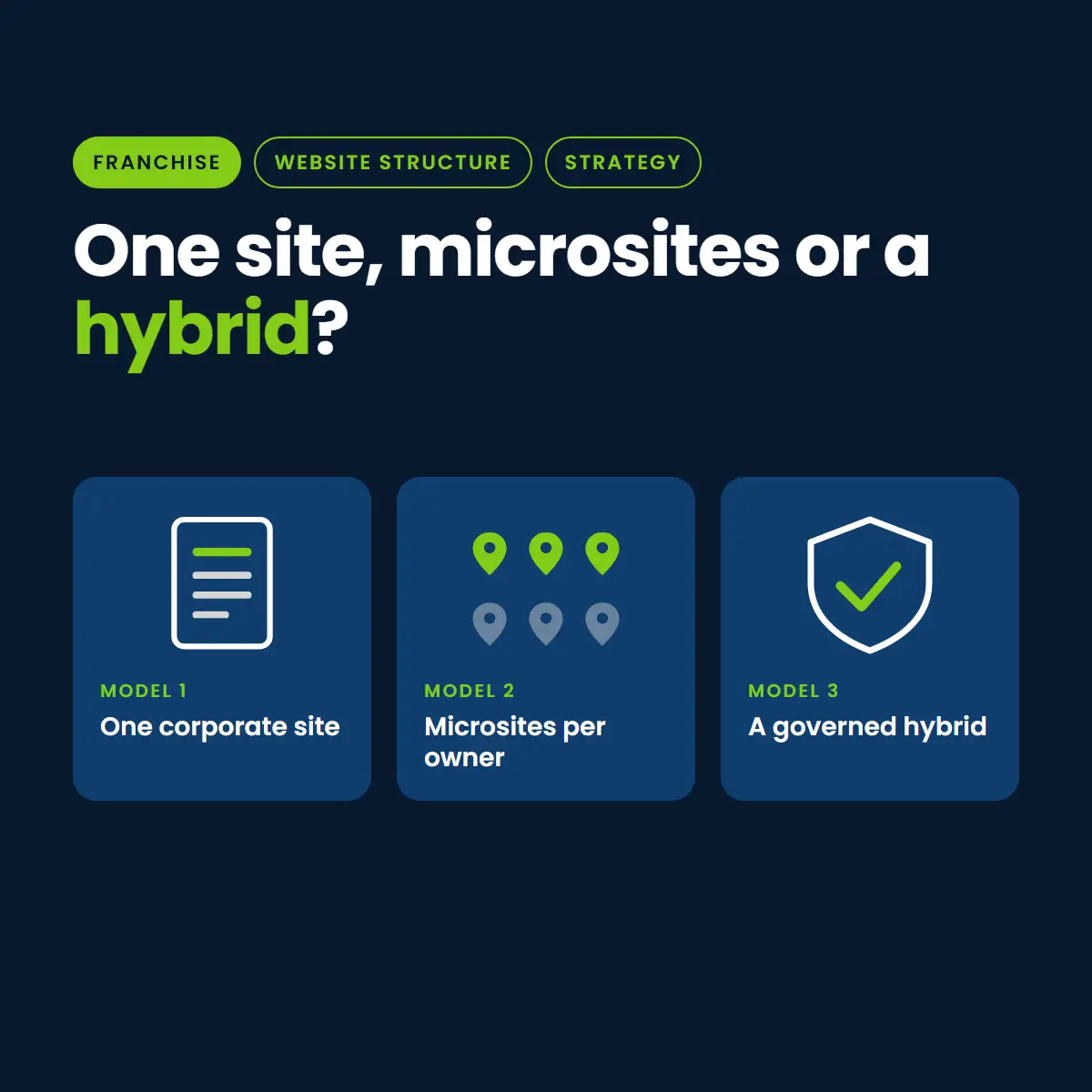
Before a franchise launches or rebuilds its website, someone has to decide how the network will appear on the web. One corporate site with a page for each location? A separate site for every franchisee? A hybrid? The choice shapes rankings, control, cost and risk for years, and it is hard to undo.
This guide lays out the options and the trade-offs, so the decision is made on purpose. It is part of our franchise website recovery guide, because the wrong structure is a common reason traffic falls after a launch.
The Three Common Models
Model 1: One corporate site with location pages
Every location lives on the franchisor’s domain, for example a folder or a page for each city. Authority and links build up in one place, and the brand stays consistent.
- Strengths: shared authority, one site to maintain and secure, consistent branding, simpler reporting.
- Risks: location pages can become thin copies of each other, and franchisees may feel they have little control.
Model 2: A separate microsite for each franchisee
Each owner gets their own domain or subdomain. They have control and can publish local content freely.
- Strengths: owners feel ownership, local content can be very specific, and a problem on one site stays on that site.
- Risks: authority is split across many domains, quality varies widely, brand drift is likely, and the franchisor pays to maintain many sites or has little oversight.
Model 3: A hybrid
A strong corporate site holds the main brand pages and the location pages, with clear rules for what each owner can add, such as local photos, team bios and reviews. Some networks allow selected owners to run a local blog under the main domain.
- Strengths: shared authority with room for real local content.
- Risks: it needs governance. Without written rules, it drifts toward either model above.
How to Choose
No single model wins in every case. Ask these questions.
- How many locations, and how different is each market? A few similar markets favor one site. Many very different markets need more local content.
- How much control does the franchisor need over brand and claims? Regulated industries often need tight control.
- Who will write and approve local content? If no one will, thin pages are the default outcome.
- How will leads be routed and reported? The structure should make it easy to see which location earned which call.
- What is the budget for upkeep? Many microsites cost more to keep current than one strong site.
What Every Model Needs
- One page per location, with its own content: the team, the service area, real projects, local reviews and clear contact details. Never a template with only the city name changed.
- Consistent business details: the name, address and phone on the site must match the location’s Google Business Profile exactly.
- Clear ownership rules: decide before launch who controls each Google Business Profile, who answers reviews, and who approves location copy.
- A defined page structure: a predictable address pattern, so redirects and internal links are easy to manage later.
- Accurate structured data: local business markup that matches the visible page, as Google’s structured data guidelines require.
Preventing Franchisee Pages from Competing
When many pages target the same service in nearby cities, they can compete with each other. Reduce the overlap.
- Give each location a distinct service area and say where it starts and ends.
- Use different local detail on each page, not shared paragraphs.
- Link each location page to its own area pages and from the main service page.
- Review search results for each city to see whether two of your pages appear for the same search.
If You Are Changing Models
Moving from microsites to one site, or the other way, is a major change. Plan it like a site move.
- Map every old address to a new one before launch. See our guide to fixing missing redirects.
- Keep a full list of the old titles, pages and top landing pages.
- Move Google Business Profile links deliberately and update them the day you launch.
- Watch Search Console daily for the first two weeks. Our post on where to look when traffic drops shows what to check.
A Worked Way to Compare Two Structures
If your network is stuck between two models, score each one against the same short list instead of arguing in general terms. Give each question a score from one to five and write one sentence of evidence.
- Authority: will links and mentions build in one place or be split?
- Local depth: can each location publish something a competitor could not copy?
- Brand control: can the franchisor guarantee accurate claims and consistent branding?
- Operating cost: what does it cost, in money and time, to keep every site or page current?
- Reporting: can you see which location earned which lead without manual work?
- Risk: what happens to the network if one site or one owner goes wrong?
The total matters less than the conversation it forces. Where the scores are close, choose the model your team can actually maintain.
Questions to Ask Before You Sign Off
- Who owns the domain, the hosting and the analytics accounts for each location, and what happens if a franchisee leaves?
- Who writes the first version of each location page, and who approves it?
- What is the written rule for what a franchisee may change?
- How will a closed or sold location be handled so its page does not become an error?
- How will we measure each location’s results every month?
Where to Go Next
Our franchise marketing and multi-location marketing pages explain how we approach networks, and our guide to multi-location website strategy goes deeper on location pages.
Planning a franchise website structure?
Not necessarily. Separate sites give owners control but split authority and make quality harder to manage. Many networks do better with one strong corporate site and unique location pages.
A strong corporate site holds the brand and location pages, with written rules for the local content each owner may add, such as photos, team bios and reviews.
Give each location a distinct service area and unique local detail, link each page to its own area pages, and review search results for each city.
Decide before launch. Whoever owns them should be named in writing, along with who answers reviews and who approves location copy.